
Is 2008 Repeating? CDS Returns to Market Focus

 Prefer us on Google


After a 15-year silence, real money accounts are once again flooding into the single-name CDS market, a scene last witnessed in 2007.
Written by: Zhao Ying, Wall Street Insights
The AI debt bubble is heating up, with an explosive growth in credit default swap (CDS) trading volume, as Wall Street is reenacting a familiar hedging frenzy.
According to the latest research data from Morgan Stanley, in September this year, the weekly trading volume of CDS related to Oracle, SpaceX, Alphabet, Amazon, Meta, Broadcom, and Nvidia exceeded $9 billion, soaring more than 4.5 times from less than $2 billion in July.
Meanwhile, data from Goldman Sachs' Fixed Income, Currency, and Commodities (FICC) division shows that the trading volume of AI single-name CDS has increased by 400% year-on-year, with the number of liquid names expanding from 4 to 10 to 12. This rapid scale expansion has led some market participants to recall the credit derivatives market on the eve of the 2007-2008 financial crisis.
Goldman Sachs credit strategist Avishek Biswas pointed out in his early October credit market strategy report that the nominal weekly trading volume of AI-related CDS per name has jumped from $50 million to $100 million last year to several hundred million dollars daily now. Manish Kabra, head of U.S. equity strategy at Société Générale, stated that CDS has become a "key barometer" for measuring the financing conditions of hyperscale cloud computing companies and overall AI trading sentiment, listing it as one of the core trades in the bank's U.S. equity outlook for Q4 2026, asserting that investors should "look at CDS, not earnings per share."
AI Debt Scale Rapidly Expands, CDS Market Erupts
Behind the AI boom is an unprecedented scale of debt expansion. According to Morgan Stanley data, as of 2026, AI-related companies have issued approximately $466 billion in bonds, more than 3.6 times the $101 billion issued in the same period of 2025. As AI companies have become the largest borrowing group in the bond market, the demand for default protection around these names has also grown exponentially.
On the pricing front, the market has sent clear signals of pressure. The 5-year Meta CDS rose to a historical high of 108 basis points this month, Nvidia reached 101 basis points, and the protection costs for Alphabet and Amazon also hit historical highs. Oracle's CDS quote surged from 144 basis points at the beginning of the year to 322 basis points, while SpaceX doubled from 110 basis points at the end of June to a historical high of 226 basis points.
Goldman Sachs cross-asset credit expert Alisha Pasi disclosed in her latest weekly report that the bank has recently received a record number of inquiries from non-traditional accounts regarding CoreWeave debt and Oracle CDS, with strong demand prompting Goldman Sachs to set up a dedicated AI cross-capital structure investor conference call, involving participants from technology, media, and telecom stocks, convertible bonds, investment-grade cash, and "distressed/AI debt trading," among others—the latter has become an independent functional line.
Why Choose CDS Over Stock Put Options
In the choice of hedging tools, the market is undergoing a structural shift. Kabra from Société Générale bluntly stated that hedging the risks of hyperscale cloud computing companies with stock put options is "extremely difficult and costly." This judgment explains why an increasing number of stock accounts are crossing asset classes to seek protection in the credit derivatives market.
Morgan Stanley also pointed out in its October 1 report titled "AI Financing Status: Pause Rather Than Retreat" that buying AI-related CDS protection "remains our preferred way to participate in the AI theme in the credit derivatives market," and expects that as banks need to manage counterparty exposure, "non-economic hedging demand" will continue to rise.
Goldman Sachs IG trader Miles McCarthy previously noted that the sources of CDS buyers are diverse: some accounts engage in directional trading with leverage or non-funding credit views, some accounts arbitrage the relative value misalignment between CDS and bonds, and some stock accounts use this to hedge publicly traded and private AI-related equity portfolios. Notably, as chip manufacturers like Nvidia, AMD, and Broadcom begin to provide seller financing and guarantees to buyers, the market has started to view them as borrowers, leading to a tenfold increase in related CDS trading volume.
Additionally, Goldman Sachs credit sales strategy data shows that last week, the CDX IG index only widened by 4.4 basis points to 62.5 basis points, while core AI names could move 30 basis points in a single day. This divergence is the fundamental reason for the market's shift from index hedging to single-name CDS—indices can no longer accurately capture the actual risk exposure held by investors.
CoreWeave: The Most Vulnerable Link
Among all AI-related names, CoreWeave is the market's most concentrated point of pressure. According to the Financial Times, CoreWeave's 5-year CDS is currently quoted at about 1090 basis points, requiring an upfront payment of $1.82 million to purchase $10 million in protection, followed by quarterly payments of $125,000—just the first year's cost accounts for about 23% of the nominal principal.
S&P Global credit analyst Gavan Nolan pointed out that "once the CDS trading price of a name exceeds 1000 basis points, the pricing logic begins to shift towards expected recovery rates," indicating that the market is pricing in a default scenario rather than merely hedging risk premiums.
Goldman Sachs had previously upgraded CoreWeave's rating, but HSBC immediately set a target price of $39 and issued a warning, stating that "the more you invest, the greater the value destruction." On October 14, CoreWeave's CDS surged from 1000 basis points to 1050 basis points during the day, closing further up at 1117 basis points, implying a probability of default of about 63% within five years. Meanwhile, South Korea's largest IPO, data center operator Elice, plummeted 32% within seconds of its listing, further confirming market concerns about the return on investment in AI infrastructure.
Robert Dafforn of Polus Capital told the Financial Times that the cyclicality in the AI financing chain means that "whichever link is the weakest will drag down the entire system first."
-- Price
From Hedging Tool to Systemic Risk Signal
Does the current CDS frenzy signal deeper systemic risks?
Structurally, demand has self-reinforcing characteristics. Goldman Sachs predicts that by 2027, the direct bond issuance scale of hyperscale cloud computing companies will reach $420 billion again, plus about $300 billion in project financing, with each new bond issuance generating new hedging demand, and every newly established special purpose vehicle (SPV), lease guarantee, or vendor financing arrangement creating new counterparty risk exposure.
Pasi also pointed out in her report that this week, the CDS of the financial and insurance sectors has also been in high demand, "as the market worries about the concentration risk of these institutions in AI trading pullbacks"—this means that the transmission chain has extended from AI borrowers to the balance sheets of financial institutions holding their bonds.
Data from Société Générale shows that the 5-year CDS of hyperscale cloud computing companies has more than doubled since early 2025, while forward price-to-earnings ratio valuations have compressed in tandem, with the divergence between the two narrowing.
The last time real money accounts returned en masse to the single-name CDS market after a 15-year silence was in 2007. At that time, they also had ample reason to do so.
This content is provided for general informational purposes only and doesn't constitute financial, investment, legal, or tax advice. Any events, rewards, online promotions, or related information mentioned herein should not be considered a recommendation, solicitation, or invitation to purchase, sell, trade, or otherwise deal in any crypto assets. Crypto assets are highly volatile and may result in loss. The availability of WEEX services, products, and related events may vary by region. You are responsible for ensuring that your participation is in accordance with applicable local laws and regulations.
You may also like
Ripple Challenges the World's Largest Banks, but Experts Warn of a Trap
Elon Musk Discusses National Debt, Reflections on DOGE, and the Robot Economy, Revealing the Truth About Superintelligence Going Out of Control
Park Soo-young: The Democratic Party Needs to Establish a Position on Digital Asset Taxation Delay

Putting Childhood on the Trading Table: TCG May Be the Closest Moment for Young People to Get Rich

AI Agents at the Singapore FinTech Festival
Bitcoin Volatility at 43%: Calmer than 19% of S&P 500 Stocks

Ken Griffin Warns AI Chip Glut Could Collapse Prices

411 BTC Awakened After 13 Years: The Wallet Targeted by the 'Noah Doe' Lawsuit Moves $33 Million

Interview with Robinhood's Senior Vice President Johann: No Competition in Public Chains, Focusing on DeFi and AI Agent for Next-Gen Finance

Samsung Wallet to Integrate USDC: What Should Phone Manufacturers Consider?

Why Crypto Platforms Want to Become Your Everyday Money App
Solana’s Yakovenko questions Alpenglow build as vote transactions exit

Bitcoin: JPMorgan Sees It Outperforming Stocks and Gold in the Long Term
Tether joins Tenstorrent’s $1.5B round as AI investments grow

110 wallets account for 99.6% of RLUSD payments on XRP Ledger

Raised US$28 million and now seeking to expand in Argentina and other Latin American countries
Claude Pushes Bitcoin and Banks to Accelerate in 53 Hours
Capital as Production Capacity: Where Did the Money of the Top 100 VC and CVC in the U.S. Go in the First Three Quarters of 2026?
Strive Surpasses Saylor in Bitcoin Purchases: What Is This Company?

Charles Hoskinson's Meme Coin Plummets Over 90% in Just Hours

After Disassembling a Genuine Ledger, TBC Discusses the True Boundaries of Self-Custody

Unitree Stock Surges: Why Shares Jumped 16% on October 19 and What Investors Should Check Before Q3 Results

SpaceX Stock Price Explained: Why SPCX Is Down From Its $225 High and What Could Move It Next
21shares launches Lighter, Venice crypto ETPs in Europe

Stablecoins Have Solved On-Chain Settlement, But How Do They Enter Merchant Checkout?
CFTC Chair: Breaking State-Level Fragmentation to Make the U.S. a Global Crypto Hub
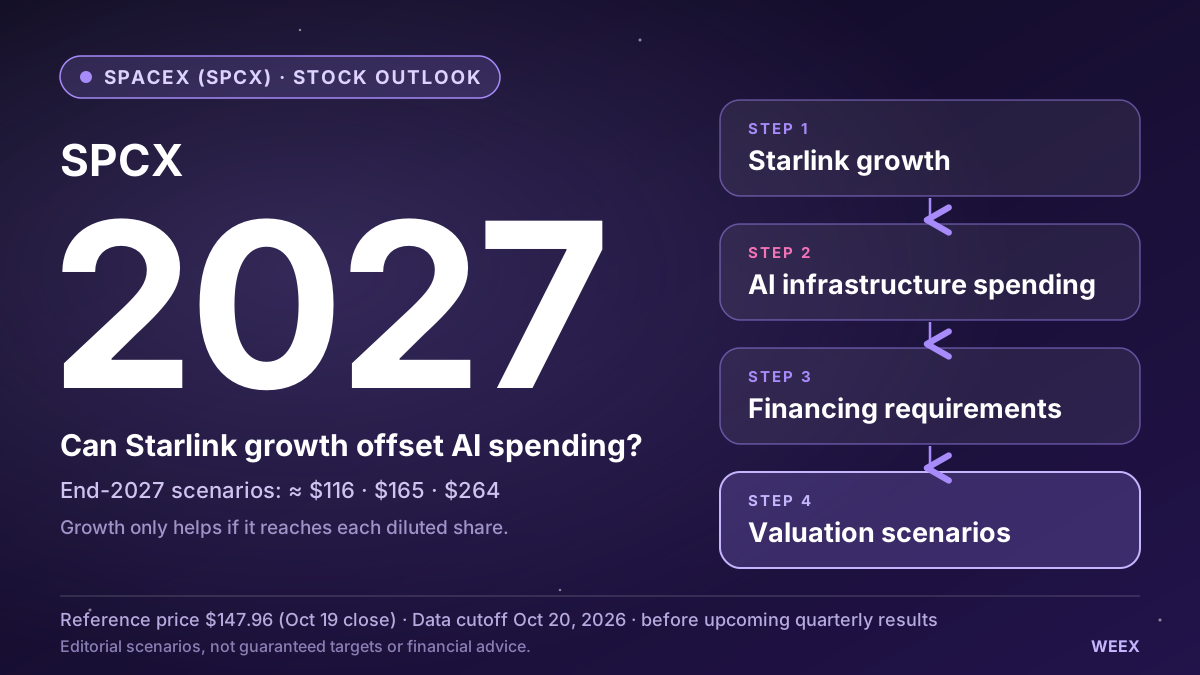
SpaceX Stock(SPCX) Price Prediction 2027: Can Starlink Growth Offset AI Spending?
SpaceX stock price prediction for 2027: assess Starlink growth, AI spending, valuation compression and dilution through transparent price scenarios.
a16z Talks to Circle Founder: Arc is More Than Just a Public Chain, It is the Foundation of the Machine Economy
NDV: Where Did the Money Go? A Review of the 16 Years of Stagflation and Wealth Erosion in the United States
Danantara Boosts Economy 30-Fold Through Technology - Fintech World
Ripple Challenges the World's Largest Banks, but Experts Warn of a Trap
Elon Musk Discusses National Debt, Reflections on DOGE, and the Robot Economy, Revealing the Truth About Superintelligence Going Out of Control
Park Soo-young: The Democratic Party Needs to Establish a Position on Digital Asset Taxation Delay
Putting Childhood on the Trading Table: TCG May Be the Closest Moment for Young People to Get Rich
AI Agents at the Singapore FinTech Festival
Bitcoin Volatility at 43%: Calmer than 19% of S&P 500 Stocks




