
47% Top Tax Rate Approaches: Seven Tax Reduction Strategies for Australian Crypto Investors

 Prefer us on Google
There is no perfect tax avoidance shortcut, only tax planning that suits one’s financial cycle and risk tolerance.
Written by: Andrew Fenton
Compiled by: Chopper, Foresight News
Australian Bitcoin holders can utilize various strategies, from establishing a Self-Managed Super Fund (SMSF) to immigrating overseas, to cope with the impending capital gains tax (CGT) hike set to take effect in 2027.
In the May budget, the Australian government eliminated the 50% capital gains tax discount for all investment categories, a decision that has significantly impacted cryptocurrency holders. Under the new tax regime, the taxable portion of capital gains nearly doubles, with only a small portion of inflation offsets remaining.
However, if preparations begin now, investors still have legitimate avenues to reduce their capital gains tax liabilities. Some Australian crypto holders have already taken drastic measures: Fred Schebesta, founder of Finder and a prominent figure in the crypto industry, chose to relocate to Singapore, where there is a 0% capital gains tax, calling this tax reform a "fatal blow."
Of course, there are also relatively mild tax reduction methods, such as setting up an SMSF, forming a company to trade cryptocurrencies at the corporate tax rate, or simply hoping that the opposition party will repeal these policies after the next election.
How Will Capital Gains Tax Change Starting July 1, 2027?
Since 1999, Australian asset holders have only needed to pay tax on half of their capital gains. Starting July 1, 2027, investors will be required to pay tax at the full personal income tax rate: 30% for gains between AUD 45,000 and AUD 135,000; 37% for gains between AUD 135,000 and AUD 190,000; and 47% for gains exceeding AUD 190,000. All amounts in this article are in Australian dollars.
Worse still, low-income groups such as students and retirees who do not receive benefits will face a minimum capital gains tax rate of 30%, regardless of their income.
The only remaining deduction is based on inflation indexation adjustments to the cost base. For example, if a property is purchased for AUD 1 million in 2027 and sold for AUD 1.5 million ten years later, with inflation maintained at 3%, approximately AUD 344,000 of the increase is attributable to inflation and is not taxable.
Swyftx CEO Andrea Yuen explains: "The challenge with cryptocurrencies is that this indexation deduction is more suited to assets with slow growth rather than high-growth assets."
For instance, if AUD 10,000 is used to buy Bitcoin and sold for AUD 100,000 ten years later, the inflation deduction would only be about AUD 3,439. Under the old policy, only the AUD 45,000 gain would be taxed; under the new policy, the taxable gain becomes AUD 86,561.
Stockspot analyst Chris Bryki compared the tax burdens of the top ten asset classes under the new regulations. He wrote in The Australian: "Crypto assets rank last because their gains come almost entirely from capital appreciation. Investments that are already speculative will see their after-tax returns shrink further."
Here are several strategies that crypto investors can adopt, ranging from simple observation to completely restructuring their financial arrangements.
Strategy 1: Hope for a Bull Market Before July 2027
Gains realized before July 1, 2027, will still be subject to the old rules and enjoy a 50% tax discount. The ideal scenario is for a bull market to push the value of holdings higher before that date. You need to keep a complete record of the valuation of all crypto assets on that day; any gains above that valuation will be taxed at the higher new rate.
Ben Simpson, founder of crypto consulting firm Collective Shift, states that the performance of Bitcoin since mid-year, under macroeconomic pressure, supports the possibility of continued growth before July. However, Simpson specifically notes that he is not a financial advisor and adds, "I wouldn’t bet everything on a bull market. I believe the Bitcoin halving in May 2028 will be the main phase for profit release. So this approach may not necessarily be beneficial for investors."
Yuen also points out that price movements are not under human control: "If you are just hoping for luck, that’s not really a strategy."
Strategy 2: Vote for Parties Committed to Repealing the Tax Reform
The opposition coalition and minor party One Nation have both pledged to repeal this tax reform if they come to power. Cryptocurrency voters who care about this policy can use this as a basis for their votes to push for a government change.
However, the ruling Australian Labor Party holds 94 of the 150 seats in the House of Representatives, making it difficult to unseat them. Even if a government change is successful and the bill passes in the Senate in time, it is theoretically possible to repeal the new policy before the 2028 tax season. More likely, related adjustments will take effect after the tax cycle. Adrian Forza, head of the Australian crypto tax agency Crypto Tax Australia, says this will make profit calculations extremely complex. "At that time, three sets of calculations will need to be done, which will be very cumbersome, but in the long run, it will be more favorable for investors."
Strategy 3: Transfer Crypto Assets to a Self-Managed Super Fund (SMSF)
Australia’s retirement system is known as superannuation, and investors can withdraw assets from their super accounts tax-free after reaching 60 years of age, with assets continuing to appreciate.
Ordinary retail super accounts do not allow clients to invest in cryptocurrencies; to avoid tax liabilities through this method, one must establish a Self-Managed Super Fund (SMSF). About one-third of Simpson’s high-net-worth clients allocate crypto assets through SMSFs.
"Continuously buying and accumulating Bitcoin within it is a very prudent approach," he says. But he warns against heavily investing in altcoins, "Retirement funds are for ultra-long-term allocation; using them to bet on short-term altcoins is equivalent to risking your retirement life."
AMP, a large Australian super fund, has invested in Bitcoin but does not open this channel to ordinary clients.
The 27-year-old founder also points out the biggest drawback of SMSFs: young crypto investors cannot access these funds for decades. "You won’t touch a cent until retirement; you can only realize profits when you are much older."
Thus, this strategy is more suitable for high-net-worth investors over 50 years old who have shorter waiting periods.
The government has also raised the operational thresholds for SMSFs, requiring extensive compliance documentation, audit requirements, and various fixed costs, making it difficult for smaller investors to bear. Annual costs typically range from AUD 2,000 to AUD 4,000; if only allocating Bitcoin or Ethereum ETFs, using online service providers like Stake can reduce annual fees to about AUD 1,330.
There is another limitation: to put crypto assets into an SMSF, one often needs to sell them first, pay taxes, and then use the fund’s money to repurchase; there is also an annual contribution limit. However, Forza states that with proper planning, one can transfer nearly AUD 400,000 worth of assets into the account at once.
Strategy 4: Use Bitcoin Collateralized Loans to Avoid Triggering Taxable Events
Many wealthy individuals are using this tax reduction strategy: using assets as collateral for loans, where the cost of repaying the loan is often lower than the taxes owed from selling the assets. Now, Bitcoin holders have many lending platforms to choose from, including BlockEarner, Vield, and Swyftx, all of which support borrowing against BTC as collateral.
Yuen laughs, saying, "We want to bring this strategy, which was originally only for the wealthy, to ordinary investors."
However, ordinary people do not have the same financial reserves as the wealthy, making this strategy very risky: loan interest rates are relatively high, and loan terms are usually only 12 months; if the market moves against them, the collateralized Bitcoin risks liquidation, and one cannot borrow against the full value of the asset, with Swyftx’s collateral rate being about 40%.
"Once the collateral value falls below the threshold, a margin call notification will be triggered," she says. "It’s akin to betting on the price of the coin going up. You must judge whether cryptocurrencies will rise or at least not plummet to trigger liquidation; otherwise, crypto collateralized loans are not suitable for you."
Simpson does not actively recommend this strategy but acknowledges that timing can yield profits. For example, if the loan interest rate is 10% while Bitcoin maintains a historical annual growth of 33%, the final profit will be better than selling directly and paying taxes. However, he warns that this is a leveraged gamble, suitable only for professional and mature investors. "If your assets are highly concentrated in cryptocurrencies and you have no extra backup funds, I do not recommend trying it; the risks are significant without understanding the rules."
Bitcoin has fallen 28% over the past year, and many investors who entered the lending market a year ago have already received margin calls and face liquidation, while also bearing interest.
Using Bitcoin as collateral for a loan to cover a home down payment has become an increasingly popular practice.
Forza also reminds that in some scenarios, crypto lending itself may be deemed a taxable event, especially in DeFi lending. For example, depositing ETH into Aave will automatically convert it to WETH, and this conversion action triggers taxation; withdrawing it will again trigger a taxable event.
Lending on centralized platforms like BlockEarner and Swyftx is currently in a regulatory gray area, and the Australian Taxation Office (ATO) has not clearly defined whether it constitutes a taxable event.
"Borrowing AUD 10,000 is not a big deal. But if you have 3 to 5 Bitcoins, I do not recommend taking the risk. Once the market moves against you, you will still have to pay taxes in the end."
"Currently, only Vield has obtained a private tax ruling confirming that its products will not trigger taxable events; other platforms have not." Swyftx stated that it has not yet obtained such a ruling and advises clients to consult tax advisors individually; BlockEarner did not respond to related inquiries.
Strategy 5: Move Overseas to Countries with 0% Capital Gains Tax
The upcoming tax adjustments in Australia have already prompted prominent figures in the crypto industry, including Finder founder, to relocate to Singapore, becoming a "tax exile" to avoid taxes.
Starting next July, the highest marginal tax rate on long-term capital gains from crypto assets will rise to 47% (with adjustments based on inflation to the cost base).
For single crypto investors with strong income growth potential, leaving Australia is becoming an increasingly attractive "ultimate option."
Singapore, Portugal, Malta, the UAE, and Hong Kong are among several popular crypto hubs that have implemented a 0% capital gains tax policy on long-term crypto asset gains to attract high-net-worth investors.
Ben Simpson, founder of crypto consulting firm Collective Shift, stated that many clients have already taken action. "Indeed, quite a few people are packing up and leaving, thinking: forget it, I’m moving to places like the Bahamas."
Andrea Yuen, CEO of Sywftx, is well aware of the tax advantages of relocating overseas.
"I lived in Singapore for 30 years and really miss the zero capital gains tax policy there." However, she did not move to Singapore for tax avoidance purposes and cautioned that relocating solely to pay less tax is a very aggressive choice.
"I would never advise anyone to plan their life solely around tax outcomes. There are many good reasons for me to choose to settle back in Australia.
If your only reason for immigrating is to avoid taxes on crypto assets, you really need to think it through carefully."
Simpson himself spends half of his year managing Collective Shift's U.S. operations and has considered immigration, but abandoned the idea after researching the relevant regulations.
"You would almost have to cut all ties with Australia. This strategy only works if you genuinely want to live overseas long-term, spend most of your time away from Australia, and give up all local healthcare and related rights."
Roger Ver, known as "Bitcoin Jesus," renounced his U.S. residency in 2014. Ten years later, he was sued for failing to accurately report the value of his crypto assets and not paying an exit tax, ultimately paying nearly $50 million to settle the case.
Similarly, investors choosing to leave Australia will face a hefty exit tax, sometimes having to sell off large amounts of crypto holdings to settle their tax obligations.
Adrian Forza, head of Crypto Tax Australia, said, "You are taxed when you leave. If you have accumulated significant unrealized gains, you will be taxed at the exit stage. Even if future tax rates are higher, you still have to sell assets to pay the tax now, which is hard to accept."
Forza added that investors can choose to defer tax payments, but when selling assets later, they will be taxed on the entire gain. So if you are optimistic about Bitcoin's future rise, paying the exit tax now might actually be more cost-effective.
Option 6: Establish a Company to Benefit from Corporate Tax Rates
27-year-old Simpson is not willing to lock his crypto assets away for forty years. Therefore, he chose to trade and hold cryptocurrencies through a company, enjoying a 25% corporate tax rate.
The difficulty of registering a sole proprietorship is not as high as imagined, but only investors with substantial funds and frequent trading would find it worthwhile. You need to register a company with the Australian Securities and Investments Commission (ASIC), pay an annual fee, hire an accountant to prepare financial statements and file corporate taxes; if you also want to pay yourself a salary, you need to manage a payroll system and contribute to pensions. When you need money, you can withdraw funds in the form of dividends.
"If you want to cap your capital gains tax at the corporate tax rate, a company structure would be very suitable." However, he pointed out a key risk: when you withdraw funds from the company, you still need to make up the difference between the 25% corporate tax and your personal marginal tax rate.
"In the end, you still have to pay tax at your personal marginal tax rate. If you are subject to the highest bracket of 47%, the result is the same as the previous capital gains tax rate."
Many people may wonder: since the final tax rate is the same, why spend money and effort to operate a company?
Simpson explained that the core advantage lies in: during your repeated trading and rebalancing, each sale only incurs a 25% corporate tax. Compared to the 47% capital gains tax, each transaction can save up to 22% in taxes, and over time, the compounded savings can be substantial.
"Originally, the profit portion would be taxed at 47%, but through a corporate entity, you only need to pay 25% tax. The after-tax funds can continue to be invested in the market, increasing your investable capital."
However, if trading frequency is very low, the applicable tax rate may rise to 30%.
Forza stated that high-income individuals benefit more from this structure: "If you are single and have an annual income of $150,000 or even $200,000 or more, establishing a company would be a great choice, especially now that the capital gains tax discount policy has been abolished."
But if you are just holding Bitcoin long-term with little trading, this structure is not very meaningful, and the benefits are unlikely to cover operational costs.
Option 7: Exit the Crypto Market to Avoid High Capital Gains Tax
The existing 50% capital gains tax discount will be replaced by an inflation-indexed discount, and the new mechanism will incorporate inflation factors into the calculation of the original cost of assets.
This means that investors who hold dividend stocks and index funds long-term will receive greater tax deductions. So should one sell crypto assets and switch to buying ETFs to save on taxes?
The short answer: it’s not worth it. This new inflation-indexed "discount" essentially just deducts the real gains after accounting for inflation, which does not constitute a true benefit.
Simpson believes that although tax reform has a significant impact on the crypto industry, crypto assets still offer an excellent risk-return ratio.
"In my view, the long-term growth potential of Bitcoin far outweighs the impact of taxes. As long as the portfolio is reasonably allocated, its upside potential remains considerable."
Historical trends show that even though the crypto market is highly volatile and has experienced prolonged bear markets, the returns from holding Bitcoin long-term, after taxes, still often outperform ETFs. However, altcoins carry extremely high risks, with returns that can double or go to zero.
J.P. Morgan predicts that Bitcoin's future annualized compound return could reach 10%
Two years ago, Simpson convinced his low-income sister, who plays basketball professionally, to buy Bitcoin instead of putting her money in a savings account. "Her holdings have already increased by 40% to 50%. She says this money will help her buy a house sooner, which is far better than cash sitting in the bank being slowly eroded by inflation."
This is also the significance of continuously accumulating Bitcoin; for most ordinary people, tax burdens are not the most pressing concern.
Yuen also mentioned that cryptocurrencies are among the few assets that can achieve double-digit returns or even double the principal in just a few months. Even under the new tax regulations, investors who realize gains are still making money.
"My father often says that making a profit is a good thing, and it is only right to pay a portion of the profits in taxes." Of course, no one is willing to pay taxes willingly, but after paying taxes, you still retain your profits.
This content is provided for general informational purposes only and doesn't constitute financial, investment, legal, or tax advice. Any events, rewards, online promotions, or related information mentioned herein should not be considered a recommendation, solicitation, or invitation to purchase, sell, trade, or otherwise deal in any crypto assets. Crypto assets are highly volatile and may result in loss. The availability of WEEX services, products, and related events may vary by region. You are responsible for ensuring that your participation is in accordance with applicable local laws and regulations.
You may also like

Trump Media adds 1,510 Bitcoin in Q3 as treasury reaches $1.17B

Bank of Korea: Consider Existing Financial Regulations When Introducing Stablecoins

Dormant Ethereum Wallet Moves $4.6 Million. Scammers Set a Trap in Three Minutes

WEEX P2P now supports ILS, BHD, OMR & QAR —Merchant Recruitment Now Open

Hyperliquid Strategies Reports 38.5M HYPE Treasury After $802M Deployment

No Music App on Work Laptops: The Small Rules Behind WEEX Security

SoftBank Reports First Quarterly Net Loss in Two Years, Intel and Data Center Dragging Down Performance
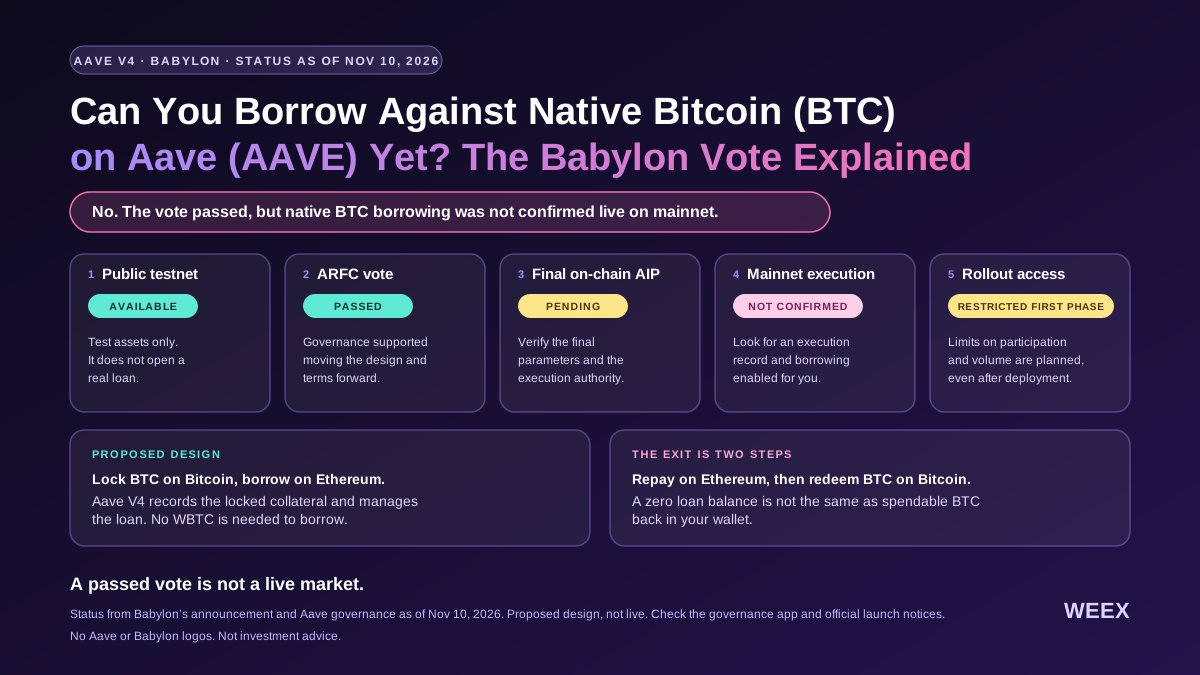
Can You Borrow Against Native Bitcoin (BTC) on Aave (AAVE) Yet? The Babylon Vote Explained
Can you borrow against native Bitcoin on Aave yet? See what the Babylon vote approved, what still needs to launch, and how BTC liquidation would work.
Why Doesn't Bitcoin Always Rise When Stocks Rally?

Financial Commission to Manage Stock Market Volatility with Sidecars and High-Frequency Trading Checks

IMF urges Kenya to make crypto firms share customer data under Travel Rule

Kim & Chang Lawyer: "Excessive Responsibility Should Not Be Imposed on Stablecoin Issuers"
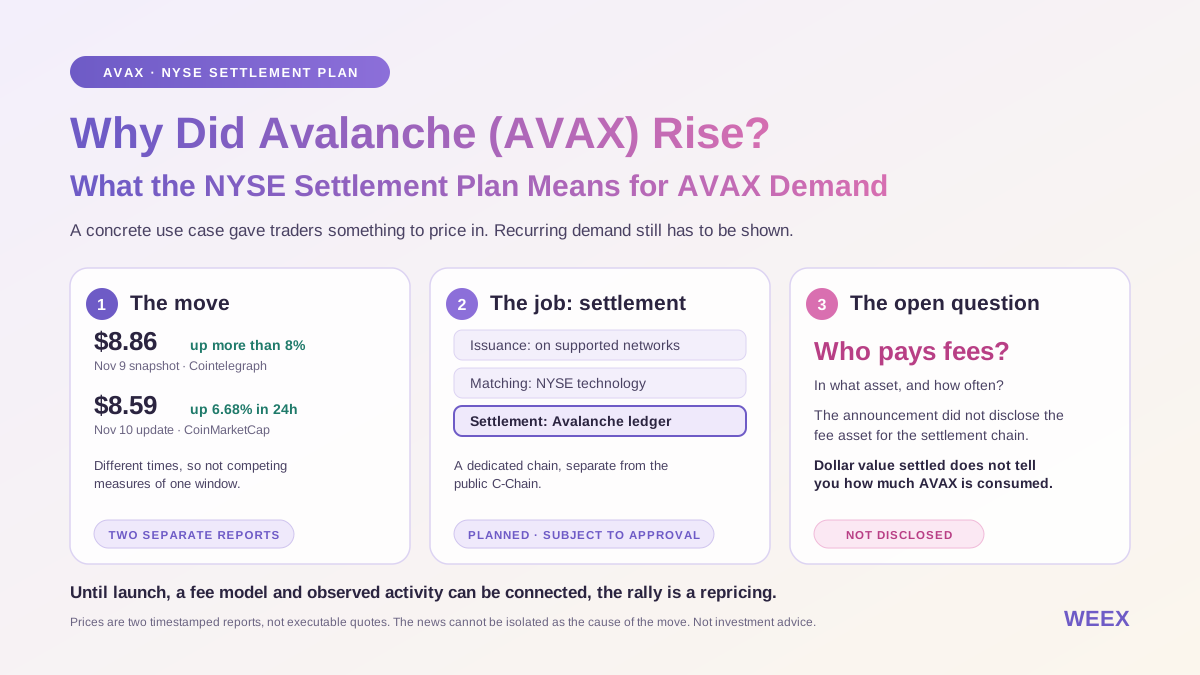
Why Did Avalanche (AVAX) Rise? What the NYSE Settlement Plan Means for AVAX Demand
See why Avalanche (AVAX) rallied after the NYSE settlement announcement, how the dedicated chain would work, and what could create demand for AVAX.

Cryptocurrency Security Checklist: Four Lessons from Phemex Safety Hub Vol. 05–08

Solana's Former DEX Leader Prepares to Go All In on US Stocks

PIEVERSE Price Up Nearly 80% in a Week: Futures Activity, the November 14 Unlock and What Is Confirmed
PIEVERSE rose about 79% in seven days with futures volume far above spot. See what is confirmed about the November 14 unlock and the WEEX Lucky Eggs campaign.

Unauthorized Access to Gnosis Pay's Old Card System Leads to Customer Data Breach

Alchemy Pay Says Mississippi Licence Expands US Money Transmission Coverage to 20 States

Hong Kong Approves Crypto Asset Reporting Rules - Fintech World

Biden's Son's LAPTOP Burns 5.5% as Conditions Met in U.S. Midterm Elections

TRON surpasses 413 million accounts, but what do network stats show?

Countdown to the GENIUS Act: Only USDC and PYUSD Pass Among the Top Ten Dollar Stablecoins

NVDA Stock Falls 4.3% After Board Opens Investigation: What Is Confirmed and What Is Not
NVDA closed at $178.67 on November 9, 2026, down about 4.3%, after Nvidia’s board confirmed an independent investigation. Other claims come from media reports. WEEX’s Lucky Eggs campaign runs until November 25.
How to Resolve Data Center Controversies? This U.S. State Wants to Tokenize Computing Power to Share Benefits with Residents

Lombard Systems Raises $4M to Make Tokenized Assets Easier to Borrow Against

When is the launch date of Bitcoin Hyper? Testnet, tokens, and mainnet are separate milestones

Westpac's Cryptocurrency Payment Limit (A$10,000): What Changes on December 1, 2026
Ethereum’s new P2P protocol doubles block delivery speed, Optimum says

Middle East Easing Expectations Boost Stocks | WEEX Daily Brief (November 10, 2026)
On November 9 close, the S&P 500 and Dow both rose more than 2%. Middle East easing expectations pushed oil prices lower. Bitcoin and Ethereum spot ETFs saw net outflows last week. AVAX rose on reports of tokenized-stock clearing. PIEVERSE surged short-term. November 10 focus is October CPI, TSMC monthly sales data, CoreWeave earnings and others.

Chainalysis Report: Why Did Western Europe Withstand the Global Crypto Market Chill?
Trump Media adds 1,510 Bitcoin in Q3 as treasury reaches $1.17B
Bank of Korea: Consider Existing Financial Regulations When Introducing Stablecoins
Dormant Ethereum Wallet Moves $4.6 Million. Scammers Set a Trap in Three Minutes
WEEX P2P now supports ILS, BHD, OMR & QAR —Merchant Recruitment Now Open
Hyperliquid Strategies Reports 38.5M HYPE Treasury After $802M Deployment
No Music App on Work Laptops: The Small Rules Behind WEEX Security
Latest articles


Latest coin listings on WEEX


