
Keplr Wallet Security Alert: Is Your ATOM Safe?

 Prefer us on Google

The Keplr wallet security incident has raised concerns across the Cosmos ecosystem after the popular cryptocurrency wallet temporarily suspended Google and Apple sign-ins following reports of unauthorized transactions. The disruption, disclosed on November 6–7, 2026, was linked to a security vulnerability in Web3Auth, the third-party infrastructure provider supporting Keplr's social-login wallets.
The Keplr wallet security incident initially attracted widespread attention when blockchain analytics firm Bitquery identified approximately $6 million in transfers from tens of thousands of affected wallet addresses. However, subsequent statements from Web3Auth and Keplr clarified that many of those transfers were part of emergency asset-protection operations rather than confirmed theft.
The Keplr wallet security incident has also put Cosmos Hub's native cryptocurrency, ATOM, under scrutiny. According to a WEEX market snapshot recorded on November 9 at 09:54 Beijing time, ATOM traded at approximately 1.324 USDT, down 3.71% over 24 hours. ATOM perpetual futures were quoted near 1.322 USDT, down 2.94%.
The incident raises three important questions: which wallets are actually vulnerable, what happened to the millions of dollars transferred to recovery addresses, and whether the security problem affects Cosmos Hub itself.
What Happened to Keplr Wallet on November 6–8?
Keplr is a cryptocurrency wallet widely used to manage assets, staking positions and blockchain applications across the Cosmos ecosystem.
The wallet supports conventional recovery-phrase accounts, hardware-wallet connections and accounts created through Google or Apple sign-in.
On November 6, Web3Auth disclosed a security issue affecting its embedded-wallet services. The company temporarily suspended the affected service while investigating the vulnerability.
On November 7, Keplr reported unauthorized transactions involving some accounts created through Google or Apple login. It subsequently paused those sign-in methods and began working with Web3Auth to investigate affected accounts.
Further disclosures indicated that the vulnerability originated in Web3Auth's infrastructure and exposed private keys associated with certain embedded wallets.
Keplr Security Incident Timeline
| Date | Development | Status |
|---|---|---|
| November 6 | Web3Auth disclosed a security incident and paused embedded-wallet services | Confirmed |
| November 7 | Keplr reported unauthorized transactions affecting some social-login wallets | Confirmed |
| November 7 | Keplr suspended Google and Apple sign-ins | Confirmed |
| November 7 | Web3Auth began protective transfers from vulnerable wallets | Confirmed by provider |
| November 8 | Web3Auth and Keplr published verified recovery addresses | Confirmed |
| November 8 | Bitquery corrected its original interpretation of approximately $6 million in transfers | Confirmed |
| November 9 | Final attacker losses, affected-user compensation and complete restoration schedule | Not publicly established |
Sources: Keplr and Web3Auth security announcements, November 6–8, 2026; Bitquery's corrected investigation, November 8.
The timeline demonstrates that the incident involved both unauthorized activity and an emergency recovery response.
It would be misleading to describe every transaction from an affected account as theft without verifying the destination and circumstances.
Was Keplr's Wallet Software Hacked?
Keplr co-founder Josh Lee stated that the vulnerability originated in Web3Auth rather than Keplr's own wallet code.
Web3Auth provides embedded-wallet infrastructure that allows applications to offer social sign-in without requiring users to manage a traditional recovery phrase during initial setup.
The reported weakness affected how some wallet keys were protected within that infrastructure.
This distinction matters because a flaw in a third-party authentication provider is different from a vulnerability in Keplr's ordinary transaction-signing code or the Cosmos Hub blockchain.
However, the distinction does not reduce the seriousness of the incident for users whose private keys may have been exposed.
Once an attacker can obtain or reconstruct a private key, the attacker may be able to authorize transactions independently of the wallet's normal login interface.
Which Keplr Accounts Are Affected?
The risk depends primarily on how a Keplr account was created.
Keplr's initial assessment identified accounts created using Google or Apple social login as potentially affected.
Accounts created using a conventional recovery phrase or connected through a hardware wallet were not identified as affected by this particular Web3Auth vulnerability.
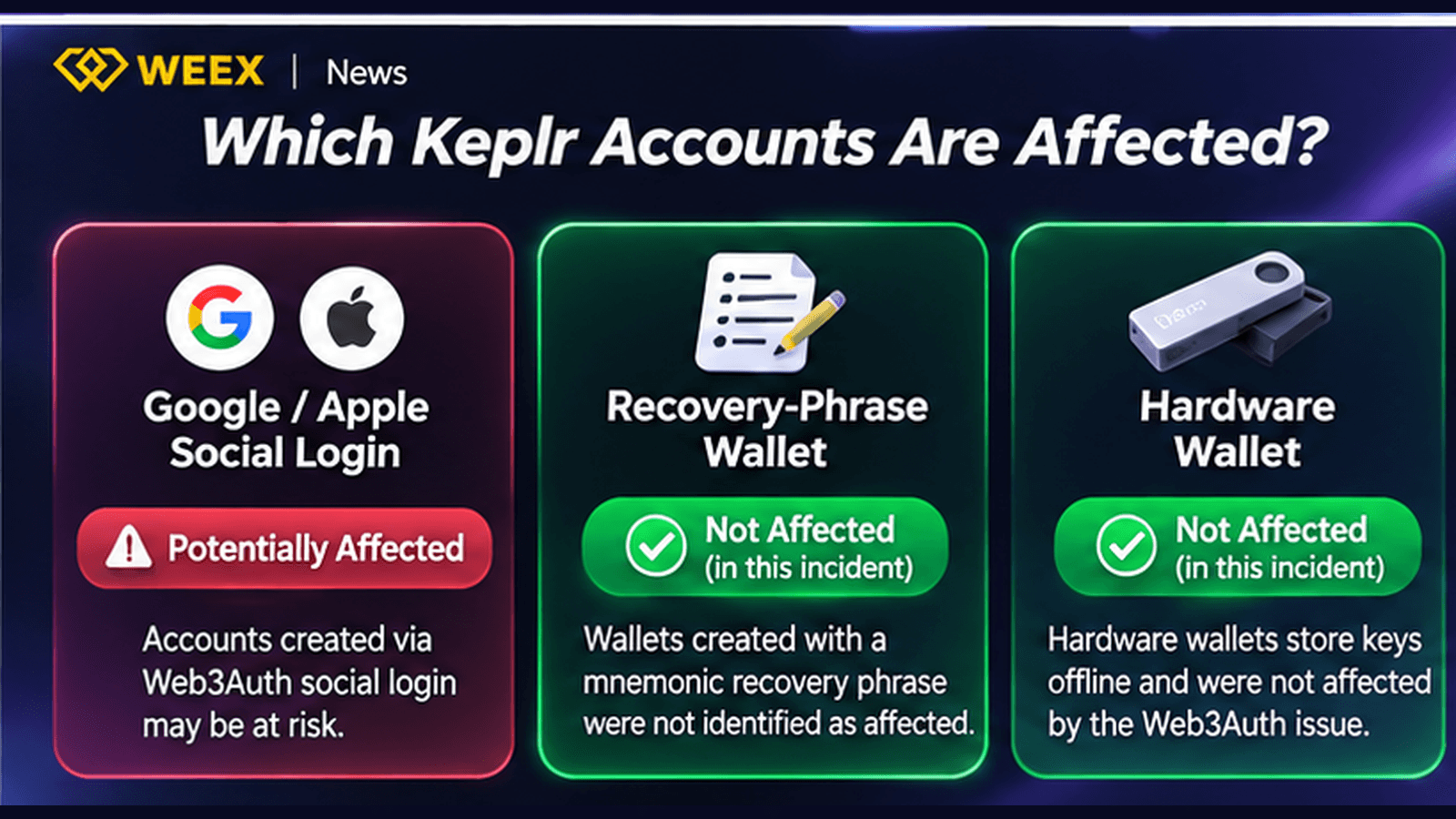
Google and Apple Login Accounts
Users who created their Keplr wallets through Google or Apple login should treat those accounts as potentially compromised until the providers confirm otherwise.
Keplr's public guidance warned users not to deposit new funds into potentially affected accounts.
The wallet also advised users with remaining liquid assets to move them to newly secured accounts using a recovery phrase or hardware wallet, while following verified security instructions.
Importantly, users should not assume that restoring access to an old wallet through the same compromised credentials makes it secure again.
Recovery-Phrase Wallets
Keplr stated that accounts originally created with a conventional mnemonic recovery phrase were not affected by the identified Web3Auth vulnerability.
These wallets do not rely on the same social-login infrastructure to reconstruct their private keys.
However, they remain exposed to ordinary cryptocurrency security risks such as phishing, malware, fraudulent transaction approvals and recovery-phrase theft.
Users should continue following standard wallet-security practices rather than assuming any wallet is immune to every possible threat.
For readers comparing storage methods, WEEX Learn's Best Crypto Cold Wallets in 2026 explains how hardware wallets isolate private keys from internet-connected devices.
Hardware Wallet Accounts
Hardware wallets store signing keys within a dedicated device rather than relying on the vulnerable Web3Auth social-login arrangement.
Keplr's initial assessment stated that hardware-wallet accounts were not affected by this incident.
That conclusion concerns the specific reported vulnerability, not every possible threat involving a hardware device.
Users should still verify transaction details on their devices and avoid fraudulent recovery websites or requests to disclose backup phrases.
Were $6 Million in Keplr Funds Actually Stolen?
The approximately $6 million figure requires careful interpretation.
On November 7, blockchain analytics firm Bitquery reported that more than 44,000 wallet addresses had transferred approximately $6.01 million in cryptocurrency during the incident.
Its original investigation attributed the movements to an attacker.
However, Web3Auth later explained that it had initiated protective transfers from vulnerable wallets to recovery addresses before attackers could reach the remaining assets.
On November 8, Web3Auth and Keplr published verified recovery addresses, prompting Bitquery to correct its original report.
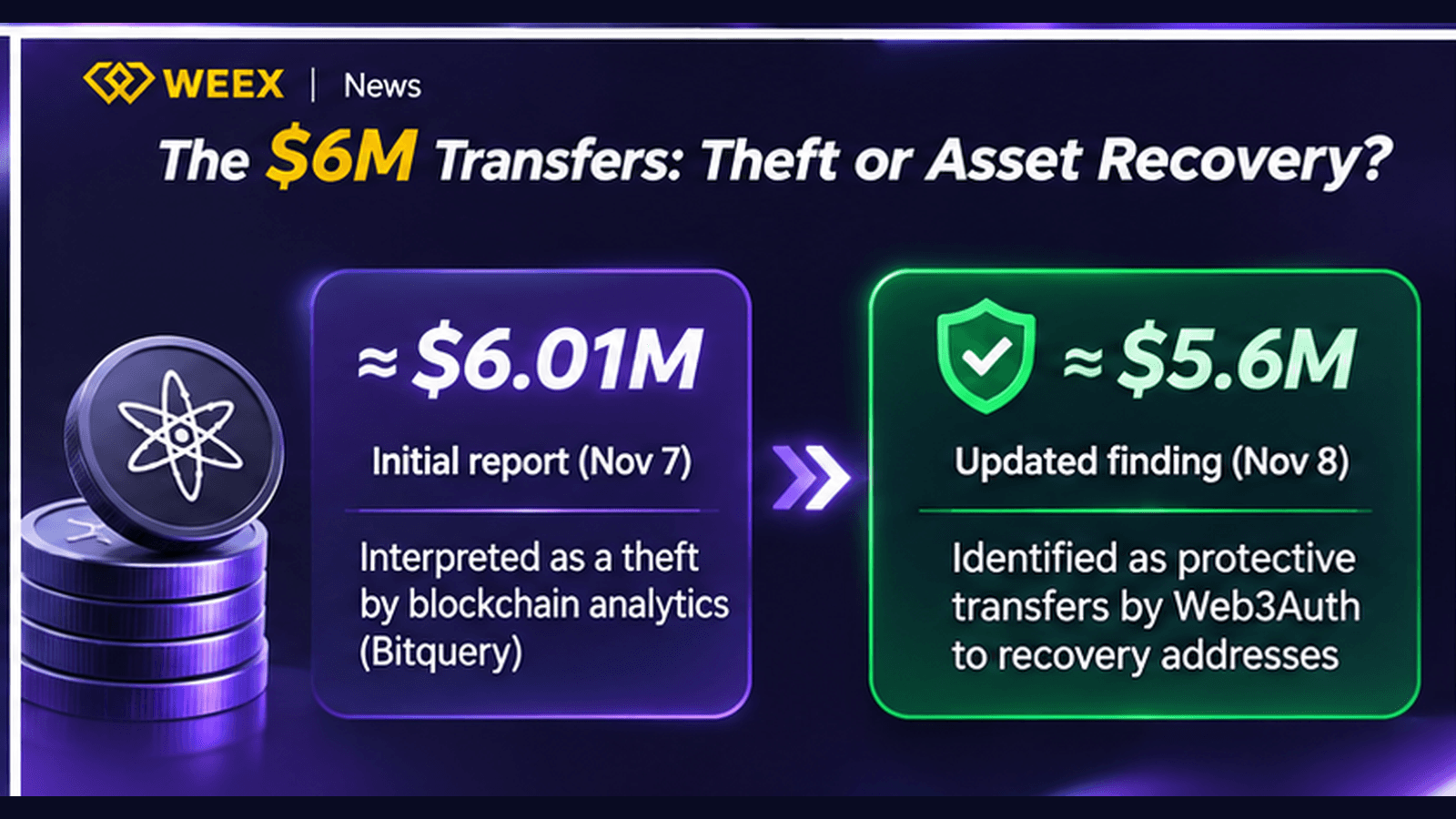
What Did the Updated Blockchain Investigation Show?
| Metric | Reported Observation | Important Qualification |
|---|---|---|
| Approximately $6.01M | Assets traced to recovery addresses at the November 7 observation point | Not confirmed as stolen funds |
| At least 44,041 addresses | Wallet addresses involved across seven Cosmos ecosystem chains | Not necessarily 44,041 unique people |
| 7,603 Injective addresses | Additional addresses involved in the tracked transfers | Also not a count of unique users |
| Approximately 1.96M ATOM | Staked ATOM moved through recovery-related transactions | Does not establish an ATOM protocol compromise |
| 12 published recovery addresses | Destinations identified by Web3Auth across supported networks | Separate from any unidentified attacker destinations |
| Approximately $5.6M | Value reported in recovery addresses on November 8 | Different timestamp and valuation from $6.01M |
Sources: Bitquery's corrected Keplr investigation, November 8, 2026; Web3Auth and Keplr recovery disclosures; The Block, November 8, 2026. Figures should not be added together.
These numbers describe observed blockchain activity and assets attributed to the recovery operation.
They do not establish the final amount permanently lost to attackers.
Why Were Protective Transfers Mistaken for Theft?
Both malicious wallet-draining transactions and emergency protective transfers can move assets away from a user's original wallet address.
From a blockchain explorer alone, those transfers may appear similar.
Web3Auth said it used access to vulnerable wallets to move assets into safer recovery addresses, attempting to protect funds that had not yet been taken by the original attacker.
Some affected users therefore saw their balances decline or disappear even though the provider reported that the assets had been secured.
This is why destination-address attribution and official confirmation are essential when interpreting large on-chain outflows.
However, the correction does not mean that no actual theft occurred.
Web3Auth acknowledged the existence of an original attacker, and the amount that attacker may have obtained had not been fully established in the available disclosures.
Are the Recovered Funds Already Back in Users' Wallets?
Not necessarily.
Transferring assets to protective recovery addresses is different from returning them to individual users.
Web3Auth stated that it was working with Keplr on an appropriate recovery process.
The providers had not established a complete public timetable for returning every affected asset or resolving all outstanding losses.
Users should therefore distinguish three stages: assets leaving a vulnerable wallet, assets reaching a verified protective address, and assets being returned to their rightful owner.
Only the last stage constitutes completed individual recovery.
-- Price
Why Were Staked ATOM Tokens Involved?
Cosmos Hub is a proof-of-stake blockchain, and ATOM is its native staking, governance and transaction-fee token.
Users can delegate ATOM to validators to participate in network security and receive staking rewards.
Under ordinary Cosmos Hub rules, users who initiate standard unbonding generally face a 21-day waiting period before their delegated assets become freely transferable.
That mechanism helps support network security and limits immediate withdrawal of delegated stake.
However, the Keplr incident involved a more complex situation than an ordinary unstaking request.
How Did Staked ATOM Move During the Recovery?
Bitquery identified approximately 1.96 million staked ATOM moving through the tracked activity.
Its investigation described a mechanism involving the conversion of staking positions into transferable representations, rather than simply waiting through the ordinary unbonding period.
This matters because users may assume that staked cryptocurrency cannot be moved during a wallet compromise.
In reality, the protections and transfer restrictions affecting staked assets depend on the precise protocols, derivatives and transaction permissions involved.
A staking position's economic exposure may be transferable through certain mechanisms even when standard undelegation is subject to a waiting period.
Does This Mean Cosmos Hub's Consensus Was Compromised?
The available evidence does not establish a compromise of Cosmos Hub's consensus mechanism.
The disclosed vulnerability involved private-key exposure in Web3Auth infrastructure.
The associated transactions occurred across networks that users accessed through affected wallet accounts.
A compromised signing key can authorize transactions on a functioning blockchain without requiring an attacker to break the blockchain's consensus rules.
For additional background, WEEX's Cosmos (ATOM) Crypto Wiki explains the network's staking, governance and interoperability model.
The incident therefore raises questions about wallet authentication, key management and the safety of interconnected financial applications, rather than proving that Cosmos Hub's underlying consensus protocol failed.
How Is Web3Auth Different From Cosmos Hub?
The Keplr incident illustrates the importance of separating infrastructure layers within a blockchain ecosystem.
Cosmos Hub is a blockchain that validates transactions and maintains its ledger.
Keplr is a wallet application that helps users access their accounts and interact with supported networks.
Web3Auth is a third-party service that supports certain wallet authentication and key-management arrangements.
These systems serve different functions, even when a user experiences them through the same interface.
| Component | Primary Role | Relevance to the Incident |
|---|---|---|
| Cosmos Hub | Blockchain consensus, staking and transactions | Transactions involving ATOM were recorded on the network |
| ATOM | Native Cosmos Hub token | Some affected accounts held or staked ATOM |
| Keplr | Wallet interface and account management | Certain social-login users were exposed |
| Web3Auth | Embedded-wallet authentication and key infrastructure | Reported source of the private-key vulnerability |
| Hardware wallet | Dedicated transaction-signing device | Not identified as affected by this vulnerability |
| WEEX | Separate exchange trading environment | Provides ATOM market products, subject to trading availability |
The problem originated at the wallet infrastructure layer.
However, its consequences could extend across multiple blockchains because a compromised account may hold assets on several networks.
Why Does Third-Party Wallet Infrastructure Matter?
Social-login wallets aim to make cryptocurrency easier to use.
Instead of creating and manually protecting a recovery phrase, a user may create an account through an existing authentication method.
The wallet application then relies on supporting infrastructure to manage the cryptographic process.
This can improve accessibility, but it creates dependencies that users may not fully understand.
A vulnerability at a shared infrastructure provider may affect several applications or blockchain ecosystems simultaneously.
The Keplr incident demonstrates why developers must evaluate third-party infrastructure security alongside their own application code.
Is Every Web3Auth or MetaMask Account Affected?
No such conclusion is supported by the available evidence.
Web3Auth stated that it found no evidence of affected MetaMask users in its initial investigation.
The confirmed Keplr disclosures concern certain accounts created through Google or Apple social login.
Other services should be assessed using their own official security notices rather than assuming universal exposure.
What Should Keplr Users Do to Protect Their Assets?
The most important action is to identify whether an account relied on the affected social-login infrastructure.
Keplr and Web3Auth advised potentially affected users to follow verified announcements and avoid untrusted recovery links.
Step 1: Identify How Your Wallet Was Created
Determine whether the wallet was established through Google or Apple login, a recovery phrase, or a hardware wallet.
The providers' initial assessment identified the social-login category as the relevant risk group.
Step 2: Avoid Depositing Funds Into Potentially Affected Accounts
Users with vulnerable social-login wallets should not send additional funds to those accounts.
Adding assets to a wallet whose signing key may be compromised could expose the new deposit to the same risk.
Step 3: Follow Official Instructions for Remaining Assets
Keplr advised affected users to move remaining liquid assets into a secure recovery-phrase or hardware-wallet account, using official guidance.
A replacement wallet must be created with fresh, uncompromised credentials.
Simply importing a potentially exposed private key into another wallet application does not make the assets safe.
Users should also avoid attempting unsupported recovery procedures involving compromised accounts.
Step 4: Verify Recovery Announcements
Check Keplr's official security updates and Web3Auth's official announcements for verified information.
Web3Auth published recovery-address information to help users distinguish protective transfers from suspicious activity.
However, users should not send funds to a purported recovery address merely because it appears in a message or social-media post.
Recovery instructions should be followed only after independently verifying the source and the required process.
Step 5: Watch for Phishing and Impersonation
Security incidents often create opportunities for attackers to impersonate support staff or offer fraudulent asset-recovery services.
Legitimate support teams should not require users to disclose private keys or recovery phrases through unsolicited messages.
Users should avoid unfamiliar links, unexpected wallet connections and requests to sign transactions they do not understand.
For a broader discussion of common wallet threats, WEEX Learn's Best Crypto Cold Wallets in 2026 explains phishing, seed-phrase exposure and transaction-signing risks.
Why Did ATOM Price Fall Around 3.7%?
The November 9 WEEX market snapshot showed ATOM spot trading near 1.324 USDT, with a 24-hour decline of 3.71%.
The Keplr security incident attracted attention during the same period, but the price movement cannot be attributed exclusively to the wallet vulnerability.
Could Wallet Security Concerns Affect ATOM Sentiment?
Keplr is closely associated with the Cosmos ecosystem and is widely used for interacting with Cosmos Hub and related networks.
Security concerns involving a prominent wallet may therefore influence confidence among some users and investors.
Uncertainty about affected balances, recovery arrangements and the safety of social-login accounts could contribute to negative sentiment.
However, the direct economic effect on Cosmos Hub depends on factors beyond wallet headlines, including whether the incident leads to sustained changes in network activity or user behavior.
Is ATOM Itself Experiencing a Protocol Failure?
The incident has not been established as an ATOM consensus failure.
The disclosed vulnerability originated in Web3Auth's wallet infrastructure.
Cosmos Hub could continue validating transactions while users of affected wallets faced account-security risks.
This difference matters because a wallet authentication issue does not automatically change ATOM's issuance schedule, staking rules or blockchain consensus.
Investors should monitor actual network data and official technical disclosures before drawing broader conclusions.
What Other Factors Influence ATOM Price?
ATOM is also exposed to cryptocurrency-market liquidity, broader risk sentiment, staking activity and expectations about Cosmos ecosystem development.
Derivatives positioning may contribute to short-term volatility, especially when markets respond to security headlines.
The difference between the -3.71% spot change and -2.94% perpetual futures change in the supplied snapshot reflects separate market instruments.
For token-specific market information, users can review the Cosmos (ATOM) price and project information page on WEEX.
Historical price movements do not establish future performance.
What Should ATOM Holders Watch Next?
The coming developments will help determine the wider significance of the Keplr incident.
Final loss accounting: A verified separation between attacker-controlled transfers and authorized protective recovery operations.
Recovery procedures: Official instructions explaining how affected users can verify ownership and reclaim assets.
Social-login restoration: Confirmation of when and under what security conditions Keplr's Google and Apple sign-ins can safely resume.
Technical findings: A clearer explanation of the Web3Auth vulnerability and what changes have been implemented.
Staked-asset recovery: Progress in handling delegated ATOM and other assets with transfer restrictions.
User confidence: Whether wallet-security concerns result in measurable changes in activity or asset management.
ATOM market conditions: Whether price volatility, trading liquidity and network staking behavior stabilize after the incident.
A complete recovery assessment will require more than an aggregate dollar value displayed on a blockchain explorer.
It will require verified ownership, transparent accounting and a documented process for returning assets.
How to Buy and Trade ATOM on WEEX
WEEX provides market pages for ATOM spot and perpetual futures trading.
Users should distinguish ordinary exchange trading from the affected Keplr social-login infrastructure.
Buying ATOM on an exchange does not require creating a Keplr social-login wallet, although any subsequent self-custody transfer introduces its own wallet-security considerations.
Step 1: Access Your WEEX Account
Sign in to your WEEX account and complete any applicable verification requirements.
Confirm that the relevant ATOM trading product is available to your account and jurisdiction.
Step 2: Prepare Your USDT Balance
Ensure that you have sufficient USDT in the appropriate trading account.
If transferring ATOM or USDT between platforms, verify the receiving address and supported network.
For Cosmos-related deposits, check whether the receiving platform requires a memo or other identifying information.
Step 3: Choose ATOM Spot or Futures
To purchase the underlying token, visit the ATOM/USDT spot trading page on WEEX.
Spot trading allows eligible users to exchange USDT for ATOM using available order types.
Users interested in derivative exposure can review the ATOM/USDT perpetual futures market.
Perpetual futures provide contractual price exposure without requiring direct ownership of ATOM.
The futures interface may be subject to trading restrictions or circuit breakers. Users must check the current market status before attempting to open or close positions.
Step 4: Review Trading Conditions and Risks
Select an available order type and review the transaction amount, displayed price, trading fees and available liquidity.
Futures traders should also consider leverage, margin requirements, funding rates and liquidation risk.
Market orders may experience slippage during periods of reduced liquidity.
Step 5: Confirm and Monitor Your Position
Review all order details before submission.
After execution, monitor your spot balance or open derivative position.
If you intend to withdraw ATOM to a self-custody wallet, verify that the destination wallet and its key-management method are secure.
Users potentially affected by the Keplr incident should follow official recovery guidance rather than transferring newly purchased tokens into an account that may remain compromised.
Conclusion
The November 2026 Keplr wallet security incident exposed an important vulnerability in the infrastructure supporting certain Google and Apple social-login wallets.
Keplr and Web3Auth responded by suspending affected services and initiating protective asset transfers.
Although approximately $6 million in blockchain outflows initially appeared to represent a major theft, subsequent disclosures clarified that many of those transfers were part of a white-hat recovery operation. The final amount actually lost to attackers and the complete individual recovery arrangements remain unresolved.
For ATOM holders, the most important distinction is that a third-party wallet authentication vulnerability does not automatically mean Cosmos Hub's underlying blockchain was compromised.
The incident nevertheless highlights meaningful risks surrounding private-key management, third-party infrastructure and staking-related asset recovery.
Investors should monitor official technical findings, recovery progress and actual changes in Cosmos ecosystem activity rather than interpreting the security headlines or ATOM's short-term price movement in isolation.
FAQ
1. Is Keplr Wallet Safe After the Web3Auth Security Incident?
Keplr's initial assessment identified certain Google and Apple social-login wallets as potentially affected. Recovery-phrase and hardware-wallet accounts were not identified as affected by this specific vulnerability. Users should consult the latest official security guidance before using potentially compromised accounts.
2. Were $6 Million in Keplr Assets Stolen?
Not all of the approximately $6 million in observed transfers have been confirmed as theft. Web3Auth and Keplr identified many destination addresses as part of a protective recovery operation. The final amount actually stolen had not been established in the available disclosures.
3. Can Users Recover Assets Moved by Web3Auth?
Web3Auth and Keplr have reported that recovered assets are being secured while a user-recovery process is developed. However, the complete return timetable and individual eligibility procedures had not been publicly finalized.
4. Did the Keplr Incident Compromise Cosmos Hub or ATOM Staking?
The reported vulnerability originated in Web3Auth's wallet infrastructure, not a confirmed failure of Cosmos Hub consensus. Some affected accounts held staked ATOM, making recovery more complex, but this does not establish that the blockchain itself was compromised.
5. Can Users Trade ATOM Spot and Futures on WEEX?
Eligible users can access ATOM market pages for spot and perpetual futures products on WEEX, subject to actual availability. Spot trading provides ownership of ATOM, while perpetual futures provide derivative exposure with additional margin and liquidation risks.
This content is provided for general informational purposes only and doesn't constitute financial, investment, legal, or tax advice. Any events, rewards, online promotions, or related information mentioned herein should not be considered a recommendation, solicitation, or invitation to purchase, sell, trade, or otherwise deal in any crypto assets. Crypto assets are highly volatile and may result in loss. The availability of WEEX services, products, and related events may vary by region. You are responsible for ensuring that your participation is in accordance with applicable local laws and regulations.
You may also like
What is Allora Network (ALLO)? A Comprehensive Guide

What is Openverse Network (BTG) Coin? A Guide to the Layer 0 Project

What Is Injective (INJ) and How Does It Work?
What is Syndicate (SYND) Coin? A Comprehensive Guide to Appchains

What is Units.Network (UNIT0) Coin: A Comprehensive Guide
What Is Mitosis (MITO) and How Does it Work?
What is Cronos (CRO) Coin

NVIDIA Board Opens Probe: What's Next for NVDA?
Midterm Elections Crypto Fallout: $170M Spent, Key Races Lost
Jensen Huang Affair Rumors: What the Alice Huang Report Says
USOR Token Price: Why the Oil Meme Coin Is Down 99% From Its Peak
XLM Token Price Today: Why Stellar's Nov. 23 Bell Vote Matters
FreeBitco.in Shutdown: Frozen Withdrawals and What Users Can Do

How to Stake Solana: Exchange vs Wallet, Rewards and Unstaking
INJ Staking ETF Goes Live: Can 90% Staking Drive Demand?

SNDK Crashes 22%: Is the AI Storage Boom Losing Steam?

Circle Revenue Hits $865M, But Can CRCL Sustain Growth?
Is GM on BSC a CZ Token? What Is Confirmed and What Is Not

What Is GM on BSC? GREEN MORNING Jumps Over 400% on a Reported Musk–CZ Meme Moment
Polygon Proposes Hard Fork to Recover 70.49M POL
Zcash NU7 Upgrade: 25-Second Blocks, Same 21M ZEC Supply
Hyperliquid ICE Deal: What US Perps Mean for HYPE Holders
Ripple National Trust Bank: What OCC Approval Means for XRP
Why Is Bitcoin Down Today? BTC's Slide to $76K Explained
Binance Hack Explained: What the $6.3B Theft Means for Users
CC Spot vs Futures on WEEX: Trading Canton's SEC Headline Risk
How to Buy USOE? What DEX Access Involves, Which Wallet and Contract Risks Apply and What an Exchange Listing Would Require
Is USOE Legit? What the Website Claims, What Independent Sources Found and What Is Still Missing
Crypto Passive Income: What $1,000 Earns in Each WEEX Product
NEAR Protocol HSP-029: Max Issuance Falls From 2.5% to 1.6%, but When Does the Change Take Effect?
What is Allora Network (ALLO)? A Comprehensive Guide
What is Openverse Network (BTG) Coin? A Guide to the Layer 0 Project
What Is Injective (INJ) and How Does It Work?
What is Syndicate (SYND) Coin? A Comprehensive Guide to Appchains
What is Units.Network (UNIT0) Coin: A Comprehensive Guide
What Is Mitosis (MITO) and How Does it Work?





